Where Is It Now
A Gentleman in MoscowWhere Is It Now? is a poem attributed to Count Alexander Ilyich Rostov and dated 1913. Its central question—where purpose can be found, or whether it has been lost—opens the novel and acquires a second life in a political hearing, where the poem is treated as evidence of its author’s former ideals and present decline. The text offers no single answer: it searches through images, places, and remembered things, only to rule them out one by one.
Identity and Origin
The poem appears under Count Alexander Ilyich Rostov’s name and the year 1913. At his later appearance before the Emergency Committee of the People’s Commissariat for Internal Affairs, Prosecutor Vyshinsky identifies it as a long poem from that year and asks whether Rostov wrote it. Rostov’s reply is guarded: it has been attributed to him. He nevertheless gives a particular account of its composition, locating it in the south parlor at Idlehour, the Rostov estate in Nizhny Novgorod.
When asked why he wrote it, Rostov says, “It demanded to be written,” describing himself as the person who happened to be sitting at the particular desk on the particular morning when it made that demand. The explanation presents composition less as a calculated intervention than as an arrival that the poet receives. That account sits in productive tension with the public meaning later assigned to the work: for its readers and interrogators, the poem is not merely something that came to its author, but something capable of calling others to action.
The Question of Purpose
The surviving opening begins in recollection, with purpose figured as a visitor that came on foot, dwelt among its hosts, and resembled a mountain cat in its melody. The poem then asks, “Well, where is our purpose now?” Rather than answer directly, the speaker describes peeling a pear with an averted eye and proceeds through a catalogue of places and objects where purpose is not to be found: autumn leaves on Peter’s Square, ashes in the Athenaeum ash cans, blue pagodas, Vronsky’s saddlebags, and the first stanza of Sonnet XXX. The excerpt breaks off after “twenty-seven red,” leaving the inventory visibly unfinished.
This movement from a remembered visitation to a sequence of absences gives the poem its distinctive uncertainty. Its locations are concrete and various, but none supplies the sought-for purpose. Even the pear is handled obliquely: the small, ordinary gesture becomes the speaker’s response to a question too large for a direct solution. The poem therefore raises the possibility of purpose without identifying a doctrine, destination, or settled answer.
Political Reading and the Hearing
Vyshinsky places the poem in the subdued years after the failed revolt of 1905 and notes that many readers took it as a call to action. Rostov accepts the broad proposition behind that reading, replying, “All poetry is a call to action.” The exchange turns on what kind of action the poem calls for: the prosecutor’s question makes its political implications explicit, while Rostov’s answer preserves a more general claim about poetry’s capacity to move people.
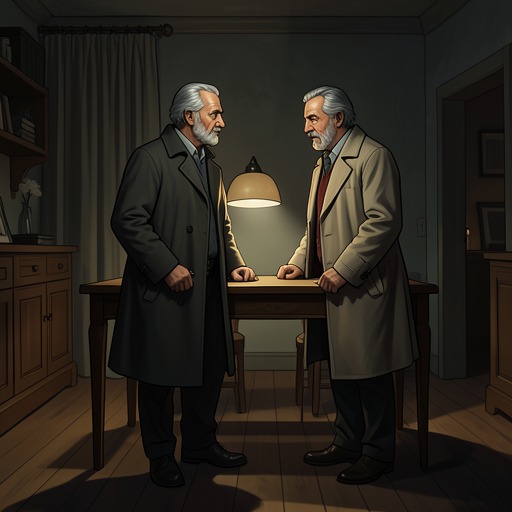
The committee’s judgment sharpens that conflict. After questioning Rostov about his return to Russia and his apparent lack of purpose, Secretary Ignatov contrasts the poem’s “clear-eyed spirit” with the man before the committee, whom he describes as having succumbed to the corruptions of his class and now threatening the ideals he once espoused. The poem thus becomes a measure against which its author is condemned. The committee says it might otherwise have him shot, but returns him to Suite 317 at The Metropol because senior Party members regard him as a hero of the prerevolutionary cause; he is warned that he will be shot if he ever steps outside the hotel again.
Place in the Novel
As the novel’s opening poem, Where Is It Now? establishes purpose as a question rather than a promise of clarity. Its searching, unfinished form contrasts with later accounts of history that confidently designate decisive dates and turning points. The narrator describes historians identifying events from the security of a chair, then names the launch of the Soviet Union’s First Five-Year Plan, Bukharin’s removal from the Politburo, and the drafting of Article 58 of the Soviet Criminal Code as milestones. Against that retrospective certainty, the poem’s catalogue keeps asking where meaning resides and refuses to settle the matter.
The novel also shows institutions converting complicated lives into procedures and records. At the Boyarsky, a meal is routed through an order pad, a ledger, a cooking slip, a kitchen log, and a stamped receipt; in the Bishop’s cabinets, reports on hotel operations sit alongside files cataloguing the shortcomings of guests and staff. These later scenes do not explain the poem or resolve its question. They do, however, extend the novel’s contrast between open-ended human purpose and systems that try to make conduct legible, classifiable, and controllable. In that larger design, the poem’s unresolved question remains active long after its author has been confined.